Agile and Scrum Methodologies
Agile vs Waterfall Project Management Differences

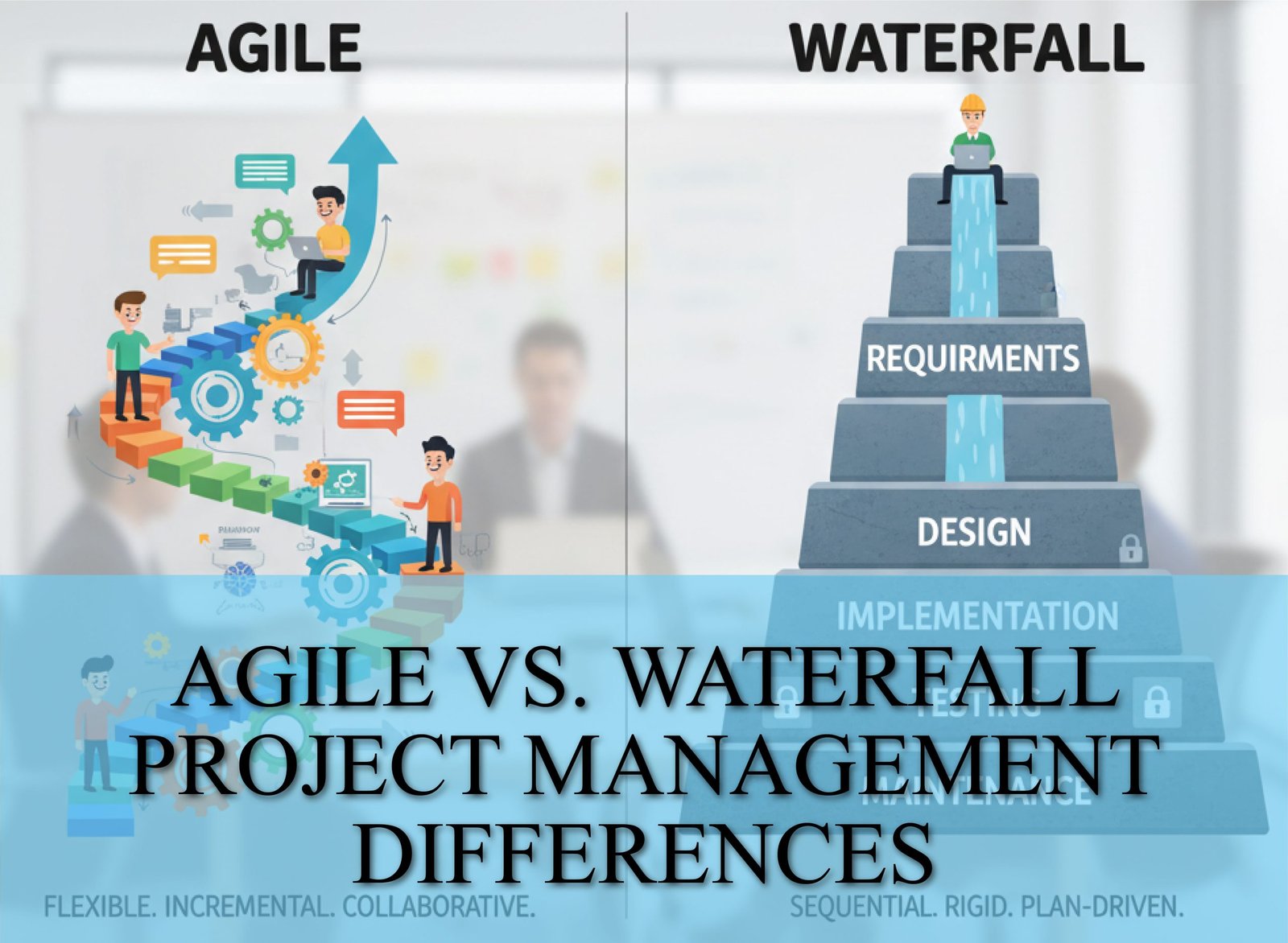
The selection of an appropriate agile vs waterfall project management methodology creates essential conditions required for achievement. Agile succeeds at projects that need flexibility and iteration coupled with constant feedback because of its adaptable nature. Scientists use Waterfall since it provides structure through linear development for projects requiring stable requirements and defined goals. The main distinctions between Agile vs Waterfall approaches become visible through this analysis of project processes, in addition to adaptability features and collaborative aspects, and delivery systems. The clear understanding of these differences allows decision-making about the most suitable methodology between Agile vs Waterfall, depending on your project style and team structure, and project duration to achieve successful execution with satisfied clients.
Methodology Overview
Two different project management systems exist between Agile vs Waterfall. Project development in Agile happens in cycles with ongoing adaptations through continuous user feedback to deliver small working components. This methodology specialises in projects with modified specifications. By contrast, Waterfall operates as a framework that demands concluding one segment of work before starting on the following sequential stage. The method provides successful results mainly for initiatives that maintain consistent goals during the project duration. The frameworks teach valuable insights that let you choose the best solution from available project frameworks according to project requirements, alongside team interaction patterns.
Agile Is Iterative
Agile breaks down projects into compact periods known as sprints which operate at a duration of a few weeks. The project segmentation into brief timeframes, known as sprints, produces operating project sections where stakeholders can give immediate feedback and initiate improvement. Stakeholders receive a review of progress at every sprint completion, and thereafter, they suggest changes and determine the upcoming actions. Through this cyclical methodology, organisations can modify their operations to fulfil changing needs, thus their projects will align with customer needs and marketplace needs, making them more adaptable and responsive.
Waterfall Is Linear
Businesses that use Waterfall must finish each development stage before progressing to the succeeding one linearly. A project begins with thorough planning and continues to the design and development phase, and testing before it reaches deployment. Completion of each sequential phase restricts the project to minimal alterations since the next step cannot be reached until the preceding one finishes. The waterfall model functions effectively for assignments with established needs which demonstrate minimal chances for modification since it delivers an unambiguous sequential implementation and limited unexpected occurrences throughout development.
Planning Flexibility
Agile systems allow adaptable project planning through their entire development phase. The team maintains the ability to change plans whenever new requirements arise throughout the project duration. The method helps maintain ongoing development until the produced output optimises with contemporary requirements. Waterfall practices demand detailed specifications along with fixed timetables to be established at the beginning of the project before the start. Changes made in project scope or direction become extremely hard and expensive to integrate after planners finalise the initial plans.
Documentation Approach
Before advancing to subsequent stages, Waterfall requires developers to document every element of their work until documentation reaches an adequate level for moving forward. The project development comprises three essential pieces of documentation, which are detailed design documents, requirement specifications and test plans. The documentation process guarantees a clear understanding, although it requires substantial amounts of time. Agile implements working solutions together with collaborative approaches rather than insisting on vast amounts of documentation. The delivery of functional features takes precedence over documentation within the Agile framework because adaptive documentation matches the project evolution.
Scope Management
During the project, Agile creates flexible administration for scope requirements. The evolving project demands require developers to modify their scope while development continues to better fit new business demands or customer needs. Agile’s main strength lies in its ability to adapt,which ensures the product satisfies present needs. Waterfall adopts an early definition of project scope, which creates major obstacles when adjustments become necessary after the initial installation. A project benefits from the fixed scope method when requirements stay stable and do not expect changes.
Team Collaboration Styles
Agile vs Waterfall implement fundamentally different approaches when it comes to working together. Agile teams use daily stand-ups as their main method for close teamwork, which brings both continuous communication and immediate adaptations. Teams that span different functional areas take shared responsibility as part of their operational approach, which allows for better openness and team-based decision processes. Waterfall presents departments with a sequential process that demands independent work during their assigned phases,despite depending on a hierarchical structure. Teams from different departments interact only at predefined stages of the project duration. The Agile method builds continuous collaborative feedback loops to enhance problem-solving capacity between team members who thus stay invested in the entire project process.
Agile Encourages Daily Meetings
Agile utilises daily stand-up meetings under the name of “daily scrums”, which serve to unite the team’s alignment and help resolve existing challenges. Each regular 15-minute standing team assembly requires members to communicate their recent achievements and planned tasks, and encounter roadblocks. Dense team communication works for maximal visibility of issues as it enables fast problem solving alongside continual advancement from start to finish during projects. These adaptations become possible due to this approach.
Waterfall Uses Milestone Meetings
Waterfall uses milestone meetings for progress evaluation and health assessment, although these meetings mostly occur during significant project stages. Team members meet at essential points during project development after planning concludes and after design completion and testing. The main objective during milestone meetings is to review how the project maintains alignment with the defined schedule specifications. Owing to linearity in operation,meetings occur at wide intervals, which results in lower communication frequency and reduced ability to adjust directions.
Agile Promotes Cross-Functional Teams
Agile creates an environment where developers share continuous collaboration with testers while working with stakeholders and other roles who all belong to cross-functional teams. Each sprint sees these teams remain active together so they can exchange both understanding and professional skills. Team members who combine their skills during work sessions achieve better problem resolution along with enhanced solutions because every member actively takes part in decision processes. The method promotes visible feedback procedures while developing products with ongoing stakeholder contributions that lead to a dynamic and reactive project development process based on continuous feedback inputs.
Waterfall Follows Role Specialisation
The standardised order of Waterfall projects splits department teams to specialize in their functions and allocate assigned responsibilities between them. The project process divides work among separate departments, which execute activities based on their assigned parts. In this work pattern, developers finish their work tasks before sending them to testers, who start testing only when development provides finished products. The project becomes more organised through specialisation, but departments struggle with communication when problems emerge late because there is little communication between teams throughout execution.
Stakeholder Involvement
During Agile projects, stakeholders participate directly across the entire process by supplying assessments with ongoing decisions during each sprint cycle. The product’s development follows the user needs through ongoing stakeholder involvement because they conduct scheduled meetings along with product updates. Stakeholders in Waterfall only participate during planning and face the project at its end, but play no role during the middle project phases. Stakeholders typically stay out of development periods, yet their expectations sometimes diverge from actual project outcomes because the implementation phase keeps postponing new requirement integration.
Project Timeline and Delivery
Project development through Agile follows separate routes from Waterfall concerning project delivery schedules. Agile delivers working products through its iterative releases that happen regularly throughout the project duration. The delivery cycle of each sprint leads to functional products that receive inspections for ongoing development. Waterfall requires developers to plan the entire project so that delivery becomes possible only upon reaching the completion point. Using this project development approach results in a specific schedule, although customers must wait until the last phase for tangible end products.
Agile Delivers Incrementally
Agile provides a functional series of small product builds through sprints that span 1-4 weeks per cycle. Delivers miniaturised, productive versions with each sprint that stakeholders can examine their application and testing of. Through an incremental method of delivery, the team can quickly get feedback that enables better modifications to both features and product improvement before advancing to new phases. Agile provides organisations with rapid product deliveries, which maintain consistent project development and user/stakeholder needs adaptation across the entire development timeline.
Waterfall Delivers at the End
Waterfall delivers the final product after executing each phase one after another in a linear fashion. The linear nature of Waterfall prevents team members from observing any finished product until project completion happens at the very end. The delayed delivery moment results in postponed issue detection, which requires considerable rework and an extended timeline whenever changes need to be made to the completed final product. The method enables the successful execution of stable requirements development projects.
Agile Shortens Feedback Loops
The iterative process of Agile allows stakeholders to deliver quick feedback at the end of each sprint, thus keeping the project connected with customer requirements. The development team stays flexible because they do real-time issue resolution and implementation of improvements through ongoing review sessions. The project’s progression becomes continuous because these brief feedback sessions enable team members to update and reshape the project through user feedback before the development reaches higher stages.
Waterfall Has Long Feedback Cycles
The Waterfall model acknowledges feedback collection only at the essential phase conclusions or once products fully reach end-users. Sequential project execution prevents developers from obtaining progressive feedback throughout the development period. The extensive delay between user feedback collection and analysis produces problems in addressing issues and improving functions, thus leading to decreased product quality while affecting its topical relevance. Additional requirements that emerge after deployment require extensive modification to the entire workflow because changes need integration across the entire system, which leads to delays and increased expenses.
Deadline Flexibility
Agile provides room for deadline adjustment because teams modify their work schedules after each sprint according to achieved objectives and gathered feedback. The adaptable nature of the project accomplishes natural change while priority adjustments become possible. The timeline remains flexible because a sprint discovery of new challenges or opportunities allows adjustments according to project requirements. The planning phase of Waterfall defines all deadlines which remain static throughout execution. Established deadlines create challenges for adaptable processes since any modification brings risks to the project timeline.
Risk and Quality Management
Each method applies different techniques regarding risk control as well as quality maintenance. Agile’s continuous testing and regular feedback system helps personnel recognise risks and quality problems early, which enables fast changes throughout the whole project duration. As a result of its cyclical project model, Agile allows teams to solve problems in real time while keeping control of adaptability and continuous development. The risk assessment in Waterfall happens during predetermined phases, yet testing is delayed until the last project stages. The delayed detection becomes increasingly challenging to identify risks or fix quality problems before finishing the project.
Agile Identifies Risks Early
Call it a virtue of Agile that it identifies risks at an early stage. The testing procedures and feedback sessions conducted after each sprint help reveal potential problems immediately, which enables the team to handle them immediately in the development cycle. Proactive management through this approach avoids problem accumulation, which decreases big interruptions in the future development process. Agile ensures the project follows its path while maintaining quality levels through fast risk response, which achieves course correction at the right time throughout development cycles.
Waterfall Has Delayed Risk Detection
The structured nature of Waterfall produces risk detection delays, which occur after multiple stages of project completion. Issues remain hidden between the development and testing phases because testing feedback does not take place until the project reaches its testing and deployment stages. The late detection of risks generates substantial obstacles that include expensive repairs and late project delivery as well as full project failure. Because of its strict process framework, Waterfall hinders teams from addressing new issues, which results in reduced risk management performance during project execution.
Agile Uses Continuous Testing
During every project iteration, Agile allows developers to integrate testing activities to provide early quality control assurance. Every sprint requires tests to validate product performance, while prompt resolution of detected problems occurs. The team makes quality improvements through early adaptations thanks to ongoing testing procedures. The tests conducted throughout the project help developers maintain both changing requirements and customer satisfaction, as well as eliminate major software flaws in the final product.
Waterfall Tests at the End
Waterfall project testing takes place after development completion since the product is finished and ready. The late testing postponement results in waiting until the final development phase to discover errors, although it becomes harder to make alterations at that point. Companies face major setbacks whenever bugs are discovered too late during the Waterfall model execution. Testing the product exclusively at the final stage hinders product adjustment to feedback since release dates are delayed, thus complicating quality assurance before deployment.
Bug Resolution Speed
The Agile development process enables teams to solve defects fast during each sprint, which helps them make quick modifications and fix issues. The product remains on course because developers can resolve issues instantly during continuous testing. Focusing on quick bug resolution enables the team to prevent project disturbances and maintain strong product quality until final release. Waterfall projects delay bug detection until their conclusion, when identifying and remedying problems results in delayed project completion.
Best Use Cases for Each Method
Agile provides optimal results for projects requiring adaptable requirements because it supports software development and product innovation, and startups’ needs for fast iterations. Bottom-up agile is suitable when market demands shift often and organisations receive regular customer feedback. Projects that demand specific requirements along with defined timelines should use Waterfall since it demonstrates exceptional results with these conditions in areas such as construction and large-scale infrastructure development. The method brings the best results when used in sectors that depend on rigorous documentation, together with sequential, organised workflows for success. Thus, it works well for projects which yield known outcomes without major changes.
Agile for Dynamic Requirements
Agile provides optimum results when client requirements or market changes emerge during the development period. The adaptable structure of Agile enables teams to perform rapid changes, allowing products to stay linked with progressing business objectives. Through Agile development, teams can modify their work structures at any time, thus making it optimal for changing situations found in software development and product creation that typically require continuous adaptation.
Waterfall for Clear Scope
The Waterfall model produces optimal results during projects which maintain static requirements and foreseeable results. Projects function best with this approach when project boundaries are determined before development starts and stand a low chance of evolution during active development. The definitive structure of Waterfall makes it suitable for project sectors including construction and manufacturing, as well as any initiative needing strict adherence to timeframes and regulatory compliance. Each phase progresses in sequence Durante la linear process to deliver a simple execution strategy for well-defined projects.
Agile for Startups and Tech Firms
Startups, together with technology firms, utilise Agile because it provides flexible project management that supports rapid response to market changes. Such industries work within environments that change quickly, as well as systems where customer requirements shift with marketplace competition. By using an iterative approach, Agile enables staff members to conduct active experiments, which produce immediate learning that enables immediate adaptations, which help products evolve with market demands as well as customer commentary. Startups leverage rapid product increment releases that generate quick product arrival to market as well as continual improvement.
Waterfall for Construction or Manufacturing
The Waterfall development model delivers excellent results when used by construction and manufacturing industries because these sectors need standardised processes that adhere to set regulations and fixed requirements. The sector gains advantages through Waterfall’s structured linear workflow because it guarantees standards and safety compliance along with regulatory adherence. The extensive planning stage of this method produces detailed documentation to examine steps before the execution point, thus minimising errors and upholding time frame and financial requirements.
Consider Hybrid Approaches
Hybrid teams decide to join Agile principles with the structured organisational methods that Waterfall offers. Agile development phases obtain their versatility from this equilibrium with Waterfall, which preserves objective documentation and project milestone management. The combination of Agile flexibility and structured Waterfall planning through hybrid approaches represents an excellent solution for controlling projects which need both adaptability and organised management during medium- to large-scale software development with complex regulatory constraints. Such a method enables teams to adapt to new conditions while enforcing both monitoring and planning control.
Conclusion
Agile vs Waterfall serve distinct purposes as project management solutions that match differently based on project requirements. Agile functions best in adaptive, flexible environments, whereas Waterfall provides outstanding results for projects which require tight timelines together with specified requirements. The ability to understand their distinctions will enable you to select the correct path toward project triumph.
Your project’s success needs a strategic boost. Today’s project success depends on correct methodology selection, so use Agile vs Waterfall strategies from which your team can benefit most.
FAQs
-
What is the main difference between Agile vs Waterfall?
The Agile development follows multiple flexible iterative steps, but the Waterfall project moves in fixed linear steps.
-
Does Agile project development execute tasks more quickly than Waterfall project development?
Agile enhances feedback speed and delivery times using its sprint, yet results from Waterfall tend to appear later.
-
Is Agile better than Waterfall?
It depends on the project. Project dynamics match Agile approaches, while Waterfall should be used for well-defined projects.
-
Are Agile vs Waterfall phases compatible for joint project implementation?
A hybrid framework becomes standard practice during the implementation of big or complicated projects.
-
Which method offers higher costs between the Waterfall project and Agile development?
The detection of early problems through Agile allows organisations to decrease total expenses.
-
What are the circumstances where implementing Waterfall proves superior to Agile?
Waterfall remains a suitable approach for predictable projects connected to strict regulatory requirements and established time constraints.
-
How do stakeholders participate in Agile vs Waterfall?
Stakeholder engagement happens regularly during Agile implementations, while Waterfall requires them to participate only at specific points during the project.
-
Which resources bring out the best features of Agile vs Waterfall?
Team members using the Agile method need tools such as Jira together with Trello, while teams working with the Waterfall approach normally use MS Project or Gantt charts.


Many teams employ Scrum as an agile framework that brings high levels of productivity together with adaptability to project management. Scrum as a development framework provides iterative functionality which enables teams to divide complex work into controlled sprints followed by ongoing reassessment sessions for adaptation. When teams adopt Scrum they develop enhanced transparency and better communication with better abilities to handle project alterations. Scrum implementation spreads throughout multiple business industries beyond software development alone. The guide encompasses every important element of Scrum including roles along with ceremonies as well as tools and practical real-world scrum implementation. Agile professionals who learn Scrum benefits will see higher project outcomes together with improved team participation.
Understanding Scrum Fundamentals
Organizations need to grasp all fundamental principles of Scrum before putting it into practice. In Scrum implementation the core values consist of focus together with commitment and openness. Work organization under Scrum relies on short time-estimated sprints with built-in cycles for regular delivery evaluation. Three primary functions operate within Scrum: the Scrum Master facilitates process progress, the Product Owner sets priority work items, and self-organizing Development Team members execute increment production. The Scrum framework implements empirical methods that demand ongoing reflective processes while requiring ongoing changes. Scrum establishes a framework which functions best for changing requirements because it emphasizes teamwork while setting priorities and creating functional deliverables.
Scrum Values
The foundational values of Scrum include courage followed by focus and commitment with respect as the third element and openness as the final value. The team members develop their mindset and conduct through these values by knocking down challenges directly while keeping priorities secure and honoring promises while respecting each individual and maintaining high transparency standards. The values of Scrum establish a workplace where employees feel protected through daily activities that combine experimental practices with feedback sessions and knowledge sharing. The established cultural framework helps both continuous improvement and trust development between stakeholders because these elements prove necessary for handling project complexities while delivering sustainable valuable outcomes with efficiency.
Scrum Roles
A successful product depends on three core roles defined through Scrum that work together for delivery. The Product Owner provides customer representation by establishing backlog priority which ensures vital features receive initial delivery. As a Scrum Master serves to both enable the team through coaching and facilitate Scrum along with clearing away hindrances blocking progress. As a self-directing group the Development Team takes backlog items to produce working product increments. These well-defined roles together achieve alignment between organizational goals and operational mechanisms because they establish shared direction among strategic planning and procedural development and execution tasks. The roles work together as one unit so that communication runs smoothly and deliverables flow consistently while enhancing accountability.
Scrum Artifacts
Scrum maintains three essential artifacts which provide clear direction and focus from the beginning to the end of the development period. The Product Backlog possesses a flexible structure that showcases all required features and requirements and enables Product Owner priority setting. Every time period the Sprint Backlog includes Product Backlog items and their delivery plans that a team selects to complete. During sprint completion the Increment reflects every project deliverable which achieves Definition of Done status. The artifacts within Scrum projects enable transparency among team members as they additionally boost mutual comprehension and ensure all stakeholders maintain alignment with project objectives.
Scrum Events
Scrum maintains five essential time-defined events which both shape work cycles and enhance team proficiency. At Sprint Planning teams establish both the needed deliverables and the required methods to reach their goals. The daily standup meeting serves as a short meeting to track ongoing work status and discover any impediments that may arise. The Sprint Review session in the final part of the sprint lets teams exhibit their work to get feedback from stakeholders. The purpose of Retrospectives is to evaluate both success outcomes and necessary improvements in work processes. Each important point in time serves us for team collaboration while permitting inspection as well as facilitating adaptation thus maintaining our ability to respond quickly to changes and consistently deliver value.
Sprint Cycle
The Scrum team devotes a limited period of two to four weeks to deliver usable product enhancements using the method known as Sprint. The selection process for backlog items happens in the first Sprint Planning event. The team maintains daily standups during the sprint period to coordinate activities while resolving any encountered obstacles. People complete their work based on the signed-off plan but remain ready to adapt when necessary changes arise. A review and retrospective event occurs at the sprint’s completion to enable result inspection and next cycle improvement. The regular daily pattern enables teams to maintain concentration and repeatable value delivery while developing discipline in their work approach to stay adaptable to changing requirements.
Setting Up a Scrum Team
The basic requirement for successfully implementing Scrum involves assembling an appropriate team. Start by assigning key roles. The successful execution of Scrum requires a Product Owner who possesses both decision powers and thorough industry market understanding. Motor skills of an experienced Scrum Master involve supporting the team while refraining from excessive control behaviors. A development team must establish cross-competency skills in order to independently create individual product increments. Scrum teams possess three essential characteristics: their membership should number between 5 to 9 members and they function as a self-organizing unit while retaining the authority to make their own decisions.
Each team member should receive comprehensive definitions regarding their obligations followed by establishment of stringent accountability standards. A successful collaboration system becomes essential when hierarchy control becomes less important. Scrum practice establishment happens best through physical or digital board scrum implementation along with communication systems and dedicated daily standup locations which drive team success.
Team Size and Structure
The best performance of Scrum teams arises from focused and compact team structures. A Scrum team needs between five and nine members who perform product ownership and scrum mastering and development tasks. The team structure allows for smooth interactions and efficient decision-making because of its dimensions. Teams with limited size avoid coordination issues yet maintain enough personnel to take on all required sprint tasks. A team made cross-functional ensures the presence of necessary competencies which allows it to produce complete product increments during each sprint while using minimal external resources or seeking approvals thus maximizing team agility.
Cross-Functional Skills
Scrum teams must consist of members who have all necessary skills which allow them to produce complete product increments independently. A group that possesses all required abilities covering software creation along with quality control assurance efforts and user interface design functions and technical documentation tasks exists as part of this structure. The team achieves autonomous work while keeping a consistent delivery speed because cross-functional integration eliminates handoffs between teams. End-to-end product collaboration occurs when silos are removed because team members can claim ownership of every task that leads to successful product development. A team must continuously work on its versatility since this capability directly supports sudden adaptation to shifting expectations and successful sprint goal achievement.
Role Clarity
Roles need to be definitively established in Scrum since this creates understanding about job responsibilities among all team members. Customers and business requirements drive the Product Owner to make strategic work prioritizations. The Scrum Master fulfills three functions by eliminating barriers and leading gatherings and ensuring adherence to Scrum guidance. Development Team members take charge of managing assignments since they are responsible for both delivering functional increments. A clear definition of roles prevents repeated activities as well as incorrect message interpretation and unclear responsibilities. Team performance increases together with work transparency in every team member , because they understand both their defined responsibilities and how their work activities assist in achieving team success.
Team Autonomy
Effective Scrum teams function best when they practice autonomy as an essential core principle. Team members have authority to determine both their work methods and solutions to problems while leaders abstain from controlling their actions. With this autonomy team members develop two positive outcomes: enhanced motivation and higher job satisfaction. Team autonomy promotes innovative behavior because members receive permission to test new techniques and tools that enhance productivity. The practice enables rapid team choices that help teams stay agile for shifting project specifications. Through trust-based leader support and delegation leaders develop organizational cultures that enhance initiative and continuous improvement with increased responsibility and accountability.
Collaboration Culture
Scrum highly depends on the existence of a strong collaboration culture. The members of the team need to experience safety which enables them to voice their thoughts and express concerns while exchanging feedback. Open communication together with psychological safety and mutual respect provide the best conditions to develop this environment. Within Scrum meetings called Retrospectives teams gain opportunities to analyze their relationships and make improvements toward better performance. The organization should shift its attention from individual achievements to collective accomplishments through teamwork. Open communication, success celebrations, and failure analyses as well as honest dialogue lead to trust creation. Team culture enables coordination of challenges and continuous development which results in improved output from products along with strengthened collective teamwork.
Creating and Managing the Product Backlog
A central role in Scrum belongs to the Product Backlog which defines all important truths. All necessary features together with improvements and resolved bugs exist in this product backlog. The Product Owner manages this backlog by organizing its contents to ensure clear items of high value. Regular backlog grooming sessions require the refinement of user stories that exist within the backlog items. Up-to-date backlog information enables the team to determine its next work tasks along with their essential business value. The business goals along with customer needs guide backlog management decisions because it functions as an important catalyst for delivering value and achieving project success.
Backlog Prioritization
The process of effective backlog prioritization determines what value will deliver the best results in Scrum. The Product Owner uses multiple factors that include what customer’s value, how fast-winding deadlines require addressing and technical constraints and broader business effects to set the item ranking. Moscow (Must have, Should have, Could have, won’t have) or weighted scoring models are used to make objective and data driven decisions about these prioritization feats. All teams constantly concentrate their efforts on assignments which yield the highest possible returns. To stay responsive and serve the needs of stakeholders and market, teams can reassess priorities on a consistent basis during the sprint planning or refinement sessions.
User Stories
Scrum needs backlog items to appear as user stories because these items establish a task structure from an end-user perspective. The form is, for example: “Given I am [user], I want [functionality] to [provide benefit].” The structure prompts teams to focus on delivering value instead of standard technical work tasks. The feedback in user stories shows product purposes to Development Teams enabling them to build direct solutions for essential requirements. The requirements become easier to understand throughout the organization because user stories present requirements in a standardized format. Success in product development depends on powerful user stories which produce higher user-driven development alongside better goal definition and produce better product results.
Refinement Sessions
The Product Owner schedules backlog refinement meetings also known as grooming to maintain accurate and sensible priorities in the Backlog which developers can execute. In these sessions the Product Owner together with the Development Team examines backlog items to define specifications then measure complexity before splitting big items into smaller tasks for sprints. Correct refinement enables better transparency throughout teams and lets members deploy effective preparations for upcoming sprints through uncertainty reduction. The collaborative discussions help the group understand both the product construction and justification while establishing achievable outcomes. Scrum teams make predictable, highly efficient workflow and velocity possible, and do this by well grooming the backlog.
Definition of Ready
A backlog item needs to fulfill the “Definition of Ready” before completing its sprint entry process. For an item to satisfy the Definition of Ready it needs to have a clear description together with defined acceptance criteria and it should be estimated by team members and feasible for a single sprint. The requirement of meeting the definition of ready prevents broad or insufficient backlog items from causing misunderstanding and scope expansion while ensuring complete delivery. The team identifies the Definition of Ready criteria alongside each other to support both quality uniformity and effective planning execution. Well-prepared items that meet the “ready” state help sprint activities begin more effectively and productively and thus prevent additional work and enhance the team’s reliability as deliverers.
Definition of Done
Team members agree through the “Definition of Done” on precise requirements for completing backlog items. A complete backlog item must fulfill criteria like coded properly and passing tests and documentation completion together with peer review and approval from the Product Owner. The Defense Department promotes uniform deliverable quality through its Definition of Done process which helps prevent unstable features from reaching release as incomplete or faulty. Through its presence the Definition of Done defines clear parameters to stop work thus decreasing team responsibility ambiguity while enhancing accountability standards. The Definition of Done receives periodic evaluations from teams who make necessary changes to ensure updated standards. This clarity enables continuous improvement, and provides the stakeholders with the reliability that is delivered.
Running Sprints and Scrum Ceremonies
However, executing Scrum functionality is to conduct time box sprints and to carry out a set of ceremonies to keep the work on track. With Sprint Planning, goals are kicked off with a shared understanding. Daily Standups provide two main benefits by keeping the team synchronized and by unblocking work progress. Progress demonstration occurs during Sprint Reviews to stakeholders followed by Retrospectives which find improvement opportunities. The gatherings foster openness and maintain unity between team members. The role of developers during the sprint is to self-organize around the tasks in the Sprint Backlog. The Scrum Master is responsible to make sure that the team is not distracted. Running Scrum is iterative in nature, which makes it rapid feedback oriented and spread over every sprint cycle.
Sprint Planning
Sprint Planning starts each sprint and builds a road to success. During this meeting the Product Owner will present prioritized items in the backlog, and the team will select what it can do given the capacity and complexity of each item. They jointly set a clear Sprint Goal—that is a concise objective that focuses and directs the team. Sprint planning helps everyone agree on what they need to achieve and what done looks like. It prevents the occurrence of misunderstandings and sets realistic expectations. At the close of the meeting, the team has a good plan and commitment to start and will go into execution with confidence and clarity.
Daily Standups
The daily Standups are time boxed meetings usually only for 15 minutes each workday during the sprint. The last three are answered by team members: What did I do yesterday? What will I do today? Are there any blockers? Through fast updates the organization maintains complete transparency and strengthens accountability across the team for immediate detection of problems. Any obstacles can be addressed through Scrum Master Intervention in order to maintain continuous progress. The benefit of standups is that it keeps everyone in sync and notified on how the things are moving without the lengthy meeting. In particular, they are not times for unstructured problem solving, they are pulse checks on the health of the Scrum Team facilitating agility and collaboration.
Sprint Reviews
The last cycle of the sprint is the Sprint Review, which is also an important place to get feedback. The stakeholders view the completed work, with as many of the features, improvements, and potential issues as the Development Team can get finished by the end of the Sprint. This stakeholder forum enables people to check developments and propose changes to future sprint priorities while offering project feedback. The Sprint Review promotes transparency, delineation of business alignment, and confirmation that the delivered item is actually providing value. Moreover, it supports accountability and maintains continuous customer engagement to help the team remain responsive to change and its resulting impact on what is most important.
Retrospectives
The Sprint Retrospectives are reflective sessions conducted following the Sprint Review. Following the Sprint Review the team meets to examine favorable aspects as well as deficiencies and ideas for enhancement leading into the following sprint. The space functions as a protected area for concerned parties to bring forward genuine reviews and practical solutions for progress. Some topics could be inefficient processes, communication fails, or tooling issues. Retrospectives enable the team to evolve continuously which makes the team more productive, more satisfied with the work they do. It usually results in a set of concrete action items or experiments to run in the next sprint to drive long term growth and performance.
Sprint Execution
Sprint Execution is the planning meets action. The team works together over the period of one to four weeks to complete a set of Backlog items and deliver a functional product increment. There is contribution of each member based on their expertise and continuous coordination during daily standups and among shared tools. Their focus is in creating high quality, testable outcomes of agreed Definition of Done. However, communication, flexibility and self-organization are essential during execution. The last step focuses on delivery of real value in a certain amount of time and rapid iteration and improvement of the iterations is possible with each sprint.
Tools and Tips for Effective Scrum Adoption
The scrum implementation becomes easier and more productive through proper selection of methodologies and digital instruments. The visualization and progress tracking processes and sprint management functions are enabled through digital platforms including Jira, Trello or Monday.com. The collaboration process gets better through communication tools which include Slack and Microsoft Teams. The use of burn down charts enables teams to track their work progress effectively. The team should maintain constant feedback mechanisms that extend beyond their members to reach stakeholders. Scrum reaches its best success when team member’s work in an atmosphere of trust through open dialogue combined with adaptability. The scrum implementation should begin with one team during the pilot phase before expanding to other teams in a systematic manner. Organize educational programs and instruction which build practitioners’ confidence while sustaining the productive use of Scrum techniques in their work.
Scrum Boards
The essential tool for viewing and tracking sprint development through Scrum Boards can exist in both digital and physical forms. The board displays segments which include “To Do” and “In Progress” and “Done.” The basic tool serves as a clarity mechanism to present current workloads because it shows instantly what needs team focus. Scrum Boards facilitate team collaboration through their transparency features which prevent bottlenecks while having everyone locate their position in the project. Remote teams can take advantage of Trello Jira and click up digital platforms which provide advanced functionality for smooth sprint management processes.
Burndown Charts
The scrum implementation of Burndown Charts serves as the primary Scrum monitoring system to track sprint advancements. The visual chart shows the progress of unfinished work against the passing time which displays the amount of work left during a sprint. The team uses the chart to determine their progress toward sprint goal accomplishment. The team must take corrective actions when the expected work reduction is not evident. Burndown charts make teams accountable through their transparency and enable teams to view workload adjustments through real-time visualizations which assist them to meet sprint goals and deadlines.
Scrum Software
The Scrum workflow receives streamlining benefits through Scrum Software entities including Jira, click up, or Monday.com which enhance team productivity levels. Through their platform users have access to a set of templates which help with product backlog management and sprint planning and both task tracking and reporting tasks. All project information becomes available at once through Scrum software which helps teams achieve better alignment. The platforms regularly offer features which provide real-time reporting functions with burndown charts and dashboards that present project forward movement. These platforms serve essential functions for distributed teams and extensive organizations which make physical boards impractical through their support of team collaboration as well as productivity and responsibility enhancement for Scrum groups.
Training and Certification
The understanding of Scrum principles and practices by entire team members depends on proper Scrum training and certification. Basic education about Scrum roles and events alongside artifacts is provided through official training programs yet certification especially for Scrum Masters demonstrates advanced knowledge of the framework basics. The understanding a team develops from proper Scrum training allows them to perform better thus improving teamwork performance and productivity rates. Scrum Masters who receive certification demonstrate their capability to lead teams while clearing performance barriers and managing Scrum events. A single training program throughout the organization creates uniformity in understanding that will consequently lead to enhanced Scrum success.
Gradual Implementation
Implementing Scrum in stages helps teams accept the framework through well-balanced changes. Implementing Scrum with a single project or team lets organizations develop their practices while avoiding massive scale-up right away. Organizations can use this approach to verify their process by applying real feedback and making updates before undertaking further expansion. The slow rollout of Scrum enables teams to tackle problems from the beginning and develop strong Scrum mastery. Scrum can be expanded into additional projects and departments through team proficiency until better organization-wide outcomes become achievable.
Conclusion
Scrum implementation for project management shifts team workflows through the promotion of teamwork and adjustment capabilities with optimal visibility standards. The correct application of Scrum activates results-driven thinking and supplies continuous feedback resulting in enhanced performance. Begin operations with modest goals and maintain persistence toward learning improvements by persistently working toward better outcomes. Proper Scrum implementation accompanied by dedication produces rapid outcomes together with contented teams and sustainable business achievement in every industry segment.
Your project management needs an advanced approach which is now ready to use. The time to begin Scrum execution yields higher team performance that results in successful project results.
FAQs
-
What stands as the essential target of Scrum within the project management framework?
The purpose of Scrum is to make fast value deliveries which integrate incremental changes alongside adaptive feedback loops.
-
Can Scrum be used outside of software development?
The flexible approach of Scrum applies across various project sectors including marketing, education and design because any project requiring changing requirements sees benefits from its scrum implementation.
-
How long should a typical Scrum sprint be?
The period for sprints falls between two weeks and four weeks with flexibility based on team needs and project difficulty.
-
What’s the role of the Scrum Master?
A Scrum Master prevents deviations from Scrum practices and clears project obstacles and maintains regular team improvement initiatives.
-
What tools support Scrum implementation?
The most common project management systems used by organizations are Jira and Trello and Asana and Monday.com for following tasks and backlog and sprint measurement.
-
Scrum establishes different management principles than conventional project handling systems?
Scrum follows a cyclic design which differs from standard project management programs that execute linearly and using fixed protocols. Change adapts better under the Scrum methodology.
-
Do all team members attend Scrum ceremonies?
Every team member must engage with pivotal events such as standups and sprint reviews alongside retrospectives since it leads to better alignment and participation.
-
Remote teams benefit from using the Scrum methodology?
Absolutely. Scrum functions well as a project management system for remote teams when team members use digital tools and maintain regular virtual meetings.

The effective management of Agile projects depends on achieving a proper combination between strategic planning and collaborative work and adaptive approaches. Agile methodologies give teams the ability to handle shifting requirements with flexibility together with maintaining their productivity levels. The three most important aspects for Agile success are constant communication along with iterative work development and ongoing feedback systems which keep projects aligned with client requirements. A thriving Agile project needs teams to divide work into smaller sections while establishing defined targets across multiple sprints followed by routine assessments of project priorities.
Project managers who establish team collaboration and hold accountable stakeholders will improve organizational performance while keeping stakeholder requirements on track. The project will achieve better success by accepting feedback while learning from completed sprints to prevent typical mistakes. The guide presents crucial advice to direct project managers through the Agile process which leads to time-efficient project completion and result excellence.
Build a Strong Agile Team
Any project benefits from an agile team which shows both strength and deep training to deliver success. Projects managed by teams knowing Agile principles completely gain superior ability to address project challenges because of their expertise in iterative development and flexible approaches and continuous improvement practices. The success of project goals depends on team members who maintain open communication that enables them to exchange ideas together with challenges and feedback.
The successful implementation of Agile requires team members to develop shared team working behaviors because Agile depends on collective problem-solving approaches. Project success depends on team members knowing their responsibilities and capabilities which allows them to perform their tasks effectively for achieving project goals. Ongoing learning alongside professional development plays a critical role since it keeps the team adaptable to deliver the best practices that adjust with changing project requirements.
Select the Right Team Members
Success in Agile requires team member selection to be the correct choice. Identify professionals whose capability to perform a wide range of duties and bring project-relevant knowledge to the table. A team made up of various competent members can handle shifting project responsibilities leading to consistent development across project stages. A team composed of versatile members both boosts operational effectiveness and leads to better project achievement.
Foster Team Collaboration
Agile success depends heavily on building active communication channels alongside teamwork among the team members. Team transparency together with project goal alignment can be maintained through regular meetings that include daily stand-ups. Efficient high-quality result delivery becomes possible as team members freely exchange information while working together which strengthens their capacity to overcome challenges.
Encourage Continuous Learning
A team’s continuous learning process must remain a priority because it helps members stay informed about Agile methodologies and their tools as well as best practices. The organization should maintain scheduled training and workshops combined with sessions that allow team members to share their knowledge to enhance their professional abilities. The learning environment promotes innovative service delivery while enabling the team to address current problems better and achieve continuous project success.
Set Clear Roles and Responsibilities
Agile projects depend on the success of teamwork because clear mandates of responsibilities maintain team performance. Team members achieve better focus on their work activities when they receive clear understanding of their duties along with their performance requirements. Project success becomes more likely when team members understand their specific assigned roles that avoid dual responsibilities. The project’s efficiency stays high while accountability remains strong because of this clear understanding.
Promote a Positive Team Culture
Positive team support structures enable better creativity and higher productivity among the workforce. A productive atmosphere should support both team success celebrations and assistance through difficult times. The building of strong relationships that support collaboration and problem-solving solutions happens through trust and respect creation among team members. Team members demonstrate their best project performance because a positive culture establishes an atmosphere which makes them feel motivated along with being valued and empowered.
Prioritize Communication and Feedback
Any Agile project demands successful communication for success to occur. The team preserves project alignment and successfully addresses emerging problems through this mechanism. Stand-up meetings together with sprint reviews create occasions for staff members to detect upcoming barriers and establish development possibilities. The practice of open communication enables team members to reveal their challenges and progress in an open way thus speeding up the resolution process. When teams dedicate resources to teamwork communication with feedback, they can preserve their project speed without sacrificing either client goals standards or team success. Strategic development through this approach results in better strategies and increased team spirit together with timely delivery of high-quality work that keeps the project on schedule.
Hold Daily Stand-Ups
Project momentum strongly depends on holding daily stand-up meetings as a key tool. These short meetings focus on checking progress while solving obstacles against achieving project objectives. The meetings create an environment where coworkers can exchange information about their work and their difficulties while verifying their alignment. Blended stand-up meetings prevent delays in project schedule and allow immediate solution of issues.
Encourage Honest Feedback
The achievement of Agile success requires both trust and transparency in an organizational culture. Team members should receive an opportunity to share genuine and helping feedback regarding project progress and encountered challenges. Team transparency enables staff to detect developing issues in advance to enable strategic changes that lead to successful obstacle resolution. The implementation of honest feedback leads to permanent development along with improved team coordination which results in superior project success.
Use Agile Tools for Collaboration
A team requires agile tools including Jira, Trello and Asana to enhance their collaboration processes and task management activities. Team members benefit from better visibility through these platforms which helps them track progress for updating their work and perform task organization efficiently. Agile tools create platforms which allow teams to work together without disruptions so they maintain absolute visibility between members while maintaining full accountability. Such tools enable teams to organize tasks according to importance as well as record deadlines and keep their attention on achieving high-quality work.
Maintain Regular Retrospectives
The Agile process depends heavily on regular implementation of retrospectives as an essential practice. Within these meetings the team finds time to evaluate their progress from the sprint and praise achievements while exploring possibilities for development enhancement. Teams can reach better productivity and efficiency through analyzing both successful and unsuccessful aspects during their work. Each successive iteration session enables the team to grow through continuous reflection thus promoting their overall development.
Foster Client Communication
Clients need effective communication for Agile projects to achieve success. The team needs to maintain constant interaction with clients to verify achievement of expectations while collecting useful client feedback. The team receives necessary information through ongoing client engagement which enables them to create products that fulfill their client’s vision. The bond that develops from excellent client communication enables better project accomplishments and stronger client satisfaction.
Manage Scope and Changes Effectively
Organizing the project objectives with effective change management makes Agile projects succeed. Agile flexibility requires proper management of scope and creep science projects tend to grow larger than their initial purpose. Project delays and increased costs together with resource strain result from scope creep. Regular evaluation of the project scope should take place during each sprint after a clear initial definition of project scope. Projects should evaluate all changes regarding their effects on deadlines and budget allocations as well as resource availability before including them. Teams preserve project goals by controlling scope effectively because this practice allows necessary alterations while keeping projects within established constraints.
Define the Project Scope Clearly
Project success depends on defining all project scope elements at its beginning. A detailed scope definition enables every team member to grasp project objectives together with deliverables and work parameters. The defined scope functions as an expectation guide for stakeholders thereby protecting the project from scope modifications that lead to project instability. The project team achieves focused alignment by setting clear boundaries at the project definition phase thus reducing risks of communication problems during the entire project cycle.
Embrace Change, But Manage It
Agile promotes adaptability yet companies need to control changes correctly to keep projects reliably on course. Project teams need to assess modifications to the scope through complete evaluation to understand their effects on resources and timelines along with expenses. New changes need proper inclusion into the project’s plan to prevent delays that would affect essential time frames. The implementation of appropriate change management enables the project to maintain adaptability together with successful completion of essential milestones.
Use Iterations to Control Scope
The project becomes easier to manage when teams divide it into smaller increments known as sprints. The team can measure progress through the delivery of particular with manageable segments while adapting as necessary. The iterative methodology gives teams room to improve the outline through user feedback so they can guide project progression while keeping essential goals intact.
Monitor Scope Creep Regularly
Expected project growth that exceeds initial goals creates two major problems – project delays and higher associated expenses. Continuous monitoring of project scope expansion enables immediate resolution of problems which helps to maintain project progress. Project managers must identify scope modifications during early development stages so they can implement proper corrective measures to preserve project timeline and budget together with quality standards. The scheduled inspections help to verify that project work stays true to its defined goals.
Engage Stakeholders in Decision-Making
The crucial involvement of stakeholders becomes essential for taking critical decisions as the project requirement evolves. Project adjustments benefit from stakeholder input which leads to solutions that match project aims together with client requirements. Major decisions that impact project direction must involve stakeholders because such participation leads to sound choices that propel project success together with stakeholder-established expectations. Mutual collaboration develops stakeholder trust and ensures project success since it keeps initiatives closely in line with what clients need.
Ensure Continuous Delivery and Quality
Value delivery serving as the key objective of Agile project management requires continuous high-quality results from beginning to end of each project. The team maintains productivity through Continuous delivery because it allows them to publish functional sections frequently thereby enabling immediate assessment and updates. Teams address problems at an early stage through this iterative method which lets them make real-time changes to meet client wants and boost satisfaction. A set of automated quality control systems and regular code inspections along with ongoing refinement deliver high standards in every project deliverable. Agile teams produce quality outcomes with minimized project risks and delays by maintaining both speed and high quality to guarantee that the project stays linked to client objectives and evolving requirements.
Automate Testing and Deployment
The development process accelerates when testing gets automated together with deployment thus providing faster detection of issues. Detection tools operated by computers identify issues at their onset which reduces testing periods that require human involvement. Teams address problems immediately through this method to shorten the overall length of the project. Through continuous integration and deployment updates become simpler and the product remains constantly deployable leading to accelerated release periods.
Focus on Delivering Value
Each project task execution strategy must work toward enhancing project value. Project tasks should receive their focus based on how well they achieve critical objectives such as better execution speed or customer contentment. Project resources will be targeting the activities with maximum impact that produce direct results for project achievement. A value-based task evaluation creates focus on essential matters within the team.
Keep Sprints Short and Focused
Timely delivery depends on succeeding through brief intense work sessions which preserve continuous project progress. The project benefits when teams divide work into separate smaller sections which allows them to concentrate on individual assignments without excessive stress. Short sprints enable quality audit tests more frequently and increase workplace productivity through agreed-upon goals. The system enables both teams and managers to track their advancement and achieve their time requirements predictably.
Encourage Cross-Functional Skills
The team increases its flexibility and adaptability when employees learn to handle different operational areas. A team that permits its members to tackle responsibilities from separate departments responds better to project changes. The adaptive processes create two essential benefits: they enhance problem-solving abilities and establish a supportive team structure through member substitution which diminishes project obstacles.
Review Deliverables Regularly
Project development gets checked through deliverable inspections that happen at the end of every sprint. Ongoing feedback from the team helps them spot problems soon after they occur while they enhance work quality and enable required adjustments. Delivering quality results depends on regular deliverable reviews that help teams control project risks and boost performance thus achieving superior project goals and improved final deliverables.
Monitor and Evaluate Progress Continuously
Project Agile success depends heavily on continuous observation for tracking progress. Teams should check and assess their KPIs together with team productivity and task completion performance to validate projects stay on time and scope. Regular performance evaluation enables project managers to detect issues early so the team can make timely corrections that prevent delay and cost problems. The regular assessment process allows teams to enhance their strategy performance and select important work while adapting resources for maximum effectiveness. Good project outcomes result from clear status understanding that consequently enables proper decision-making while maintaining team alignment with client objectives.
Track Key Performance Indicators (KPIS)
Monitoring appropriate KPIS serves as a necessary tool to evaluate Agile project developments. The project’s health becomes clearer through analysis of performance indicators including velocity alongside defect rates along with team productivity figures. Project managers obtain valuable insights that lead them to improve projects while making resource adjustments to keep teams aligned with their targets through monitoring selected metrics. Project performance benefits from using KPIS because data-based decisions result in superior outcomes.
Use Burndown Charts
The visualization capability of Burndown charts proves them to be an excellent resource for tracking project development. The device reveals the quantity of uncompleted tasks as well as the duration of the remaining work period. Burndown charts demonstrate current project status to teams thus enabling them to determine whether their work schedule requires updates. Burndown charts promote visibility because they provide both team members and external stakeholders with real-time project speed information.
Regularly Review Project Goals
Project team members stay dedicated to client expectations through periodic evaluation of project goals. The goals should undergo revision when projects undergo changes which either reveal additional information or introduce new demands. Goal updates provided to the team enable flexible practices and maintain essential deliverables as the main focus. The practice results in more effective project alignment through improved clear communication.
Adjust Strategies Based on Feedback
The utilization of feedback provides professionals with a strong mechanism to perfect their project strategies. Team members who receive feedback from clients along with stakeholders can improve their future operation through Sprint adjustments. The inclusion of feedback throughout the project plan enables early issue resolution and continuous enhancement so the project develops in the most productive manner toward objective satisfaction.
Maintain Focus on the End Goal
The end goal must be continuously visible to team members because this creates both project success and team motivation. Project-wide purpose reminders throughout time help train employees’ collective efforts towards work value recognition. Team morale and enthusiasm increase through small achievement celebrations which simplify hurdle overcoming and strengthen dedication to complete the primary goal
Conclusion
For successful Agile project management, you need to maintain three key elements between teams and communications and adjust to changing circumstances. Teams who adopt these best practices will achieve better collaboration and achieve better scope management and quality outcomes and successful deliveries. Agile project management involves continuous adaptation to changes so teams can achieve their main purpose of delivering valuable outcomes for clients and stakeholders.
The tips will become effective for your Agile project when your team begins their implementation. Knowledge seekers who need additional assistance in Agile project administration should make contact with our team. Contact us now to receive expert advisory services.
FAQs
1. What is Agile project management?
Agile project management functions as a task management system that operates in cyclic patterns through continuous feedback loops and groupwork with adaptable plans to achieve value-based results.
2. How do you manage scope in Agile?
The management of project scope consists of establishing precise goals before execution and it requires ongoing progress reviews to implement necessary changes through scope creep control.
3. Communication plays a vital role in Agile projects because of what specific reason?
The alignment of project objectives becomes possible when communication remains clear since this practice enables prompt issue detection and supports team member and stakeholder collaboration.
4. What is the role of feedback in Agile?
Agile projects depend heavily on feedback because it enables teams to create enhanced outcomes which resolve stakeholder concerns and enhance deliverable quality for better customer satisfaction.
5. What methods does Agile use to monitor development movement?
The project tracks its progress through burndown charts together with KPIs and recurring assessment meetings to check team work rate and project fitness.
6. What is a sprint in Agile?
Agile projects rely on sprints as their fundamental time-based repeated development cycles spanning between one week to four weeks to complete assigned work before review and feedback sessions.
7. What steps would be best to enhance Agile team collaboration?
The team will collaborate better when members know their tasks through open communication and regular stand-up meetings and clear understanding of responsibilities.
8. What are the steps for guaranteeing quality in Agile projects?
The project Requires regular testing cycles together with post-sprint assessment procedures and training to enhance team abilities across different domains for quality maintenance.

Agile project management has been characterized by adaptability, teamwork and flexibility to altering needs. But Agile does not come without its problems though. The key challenges facing organizations in their Agile adoption efforts include agile resistance (inability to adopt Agile due to lack of desire, knowledge, and skills), inadequate competent teams, and problems in communication and alignment among the stakeholders in organizations. The above challenges may impede successful adoption of Agile, and impact on team productivity. Also, Agile is iterative, and during its iterative process, there is the prospect of scope creep or losing its direction as it may become derailed regarding the project objectives.
The misunderstandings of the principles of Agile, the absence of defined roles, or inadequate buyer-in among the leaders can become barriers as well. Recognizing, and solving all these challenges during initial stages are important to influence proper execution of Agile practices. This blog will discuss some of the most popular problems of Agile project management, and offer workable solutions to address these problems. The challenges, as described, are to be known and proactive steps taken regardless of whether you are the Scrum Master, Product Owner, or a team member so that collaboration, productivity, and Agile methodologies work in the way that they are expected. Tackling these concerns will result in easier implementation of the project, and long term success of the Agile methods.
Resistance to Change and Cultural Shifts in Agile Adoption
Change resistance is one of the issues that should not be underestimated when implementing the Agile methodologies. The historical working ways, as well as the corporate culture that has been already established, become the obstacles on the way to the successful implementation of Agile. Leaders, and workers that have gotten used to making decisions hierarchically or using strictly defined procedures might not adapt to the Agile approach of collaboration, and flexibility. The way to get over such resistance involves effective leadership genuinely championing the change, communicating the advantages of Agile, and training to instill required skills to the teams.
Also, it is essential to encourage the culture of trust, and openness because Agile focuses on collaboration, and constant improvement. The organizational resistance caused by misconceptions, and gaps in a support system is something that can be reduced or eliminated by communicating the concern, assisting them in getting the proper support, and being the example, which helps organizations to overcome the challenge, and establish a more productive service to facilitate Agile practices, and deliver successful project results.
Organizational Culture Clash
Agile involves moving away with the conventional project management towards a collaborative, flexible, and an iterative approach. This transition tends to conflict with the cultures that are already in place in organizations as they can be vertical and strict. To resolve this conflict, leadership, effective communication, and the readiness to adjust to the Agile collaborative system may help to find a consensus, and facilitate change.
Fear of Losing Control
Under the influence of autonomy, and self-organizing teams stipulated by Agile, the managers and the team members are likely to develop fears that they might lose control. To clarify this, one should explain that Agile is a method which enables teams to perform their duties but keep in line with organizational objectives. An open method makes it, so that there is control in the right direction, and collective responsibility.
Lack of Agile Training
Novice teams can have a hard time in using Agile practices. An essential attainment to ease the effort would be to train all stakeholders, consisting of the Scrum Masters, the Product Owners, and the team. Agile principles, and practices should be taught accordingly so that teams get to understand what is expected of them, and how to implement Agile approaches to achieve success in their projects.
Misalignment Between Teams and Leadership
Not always are the leaders aware of the Agile principles or do they have the same expectations with the teams. Education and an open dialogue process keep the leadership consistent at every level of the organization in terms of Agile principles employed. The interaction helps both teams and the leadership to work towards a common vision through the principles of Agile using Agile practices.
Unclear Agile Roles
Role ambiguity like the Scrum Master, Product Owner, and the team members may cause confusion and ineffectiveness. THE responsibilities, and roles clearly described in the Agile framework should help all the persons to be aware of their individual contributions to the project. This transparency will facilitate efficient group work, as well as reduce cases of misunderstanding, thus enhance the overall project implementation.
Managing Scope Creep and Changing Requirements
Agile has adaptability as one of its important benefits because it has the capability to respond to fluctuating needs. Nevertheless, the flexibility may result in scope creep, whereby the scope of the project increases more than what is anticipated in the course of the plan, resulting in the project postponement, and possible cost overruns. The ability to cope with changing needs without getting the project derailed is one of the challenges often met in Agile. The first solution bursting from the scope perspective is that the clear definition of the objectives should apply, and appropriate prioritization should take place so as to eliminate scope creep.
The frequent contact with stakeholders is also essential, so that the new requirements could be in line with the project objectives. Also, implementing such practices as backlog grooming when the team discusses, and prioritizes the tasks on a regular basis can contribute to making sure that the most urgent changes will be implemented. Teams can accommodate all the needs by remaining true to their vision and rely on delivering value. The needs may change but eventually, not affecting the success of the entire project.
Prioritizing Backlog Items
The critical aspects of preventing Agile teams to be bogged down with continuous changes are effective prioritization. Techniques, such as MoSCoW ( Must have, Should have, Could have, Won’t have) makes it rather sure that only the most important issues will be made to work. This kind of approach keeps the project in track with what matters to the team, and also helps them not to be distracted by what does not matter to the project.
Balancing Customer Requests and Project Goals
It may be difficult to balance the demands of customers, and the objectives of the projects. Agile teams will have to be in constant contact with stakeholders, so that the new requests serve business purposes. Reasonable reassessment of project objectives and evaluation of customer experiences allows establishing a balance between the incorporation of modifications into the project, and altering the initial vision, as well as recurring delays.
Defining Clear Requirements for Iterations
Confusion and rework may result because of unknown or ambiguous requirements. In every sprint, it is important to establish concrete, and do-able user stories and acceptance criteria. This will avoid unnecessary changes, keep the team focused on providing value, minimize the chances of scope creep, and help enlighten the project.
Managing Stakeholder Expectations
Such a continuous change may bring dissatisfaction in case the expectations of stakeholders are not handled well. There is a need to teach Agile stakeholders about its iterative character and how the changes can affect the schedules. Communication with clarity of what is actually achievable naturally aligns with expectations and avoids frustration as projects become successful.
Continuous Refinement of the Backlog
Backlog refinement on a regular basis helps to keep the team members involved in the most valuable work. The Product Owners are advised to prioritise items on the backlog depending on the feedback, market changes, and capacity of the team. The constant improvement process assists in controlling scope creep, which makes sure that the project is focused on creating high-valued tasks.
Communication Challenges in Agile Projects
The right communication is the key to successful project management with the help of Agile, and it is also not always easy. Agile teams should be active in terms of communication between all parties, and it should be crystal clear between members of the team, clients, and the management to facilitate consensus. Nonetheless, there may be a lot of miscommunications, misunderstandings, or information gaps since Agile is iterative, and rather fast. This may cause problems of mismatched expectations, or delays or scope creep. Moreover, distributed stakeholders, or remote teams might have a problem with on-the-spot communication. Constant check-ins, stand-ups, and powerful collaboration tools can assist in addressing communication gaps. Being as open as possible, creating an atmosphere in which all people can express their concerns easily is essential to solving these problems and getting projects on schedule.
Lack of Clear Communication Channels
Communications issues are encountered when the information is not shared in an organized manner. Effective communication in agile teams Agile teams are encouraged to define effective communication channels, including daily stand-ups, sprint reviews, or collation tools like Slack or Microsoft Teams. These will establish regular open communication channels that will bring the team in line, solve problems in a timely manner, and keep everybody on track.
Remote Work and Distributed Teams
Remote or distributed teams may have the problem of effective communication, and collaboration. Communication pitfalls are narrowed with the help of digital tools, such as Slack, Zoom, and Trello, which allow engaging in real-time communication, and maintaining the team in touch. Such tools facilitate a smooth process of collaboration, so that the cohesion of the team can be maintained and the contribution of every member of a team can be achieved, despite his, or her location.
Inconsistent Updates and Feedback
Feedback is necessary in Agile and it should be active. Failure to update in a consistent manner or provide input encouragement often results in confusion, and misalignment. It is important to cut sprint reviews and retrospectives and keep the stakeholders aware of what the team is doing and what it has achieved, providing the team with feedback to proceed accordingly, and control the scope.
Cross-Functional Team Collaboration
Agile teams are usually composed of people with different levels of expertise, and cross team work may prove difficult. Promotion of open communication, and collaboration is the key to success. Role clarity, and normal team-building sessions enhance synergy so that every team member has his/her role to play, and is focused on achieving togetherness when pursuing the project objectives.
Communication Between Development and Business Teams
Poor communication between the business stakeholders, and a development team may lead to wrong expectations and delays in the project. Constant interaction when making the sprint planning, reviewing as well as retrospectives is necessary to avoid this. The interactions keep the two teams on course in terms of goals, dates, and deliverables and, therefore, reduce the chances of misunderstandings, making the project successful.
Balancing Speed and Quality in Agile Projects
Agile is all about working fast, though in fast iteration, it is the quality of work that may be a concern. Speed needed to meet deadlines and customer demands can easily be compromised by minimizing quality resulting in defects, rework, and customer dissatisfaction. In order to find the right balance, the Agile units should see to it that quality is integrated at all stages of the process, including planning, and testing. Keeping things fast can be facilitated through continuous integration, automated testing, and frequent code reviews which allow keeping the quality high.
Moreover, establishing value-driven priorities, and working on producing the maximum effected features guarantees that the team should be working on the most significant factors of the product always. With this mixture of speed, and quality, the teams would be able to ensure their deadlines are met, as well as provide a quality product that would be able to meet the customer expectations, and long-term goals.
Implementing Quality Assurance Practices
Quality assurance (QA) must be built into all points of the Agile process. Continuous integration, and automated testing, as well as regular reviews of the code are effective in ensuring quality and pace with the development process. Such practices will help to recognize the problematic areas early enough, reduce defects, and rework and enable the team to complete the project with high speed and quality.
Managing Technical Debt
Technical debt may build up when features are rushed to be implemented in an attempt to finish them faster. The techniques of managing such technical debt include regular refactoring, making technical commitments part ,and parcel of the value chain, and thinking about the long-term health of the code. When taking care of the technical debt promptly, teams safeguard the product against unserviceable, unscalable, and poor-quality hindrances without sacrificing the pace of its future development
Striving for Perfection vs. Iterative Improvement
Agile does not require perfection per iteration, but strives towards iteration-to-iteration fixes. The teams ought to develop features which are just good enough, and perform iterations with time. By emphasizing on iterative, rather than perfection on every sprint, it becomes possible to deliver faster and also make sure that the product changes, and improves with each iteration.
Sprint Planning for Realistic Deliverables
Effective sprint planning makes the teams capable of producing quality work within the boundaries of the sprint. It is essential to split work into small pieces, and make them achievable in a sprint. Planning prevents the unpleasant situation of overcommitment of teams, and makes it possible to deliver the results with the appropriate mixture of quality and speed, which results in a realistic, and achievable deliverable.
Customer Feedback and Iteration
The need for customer feedback in Agile projects is essential in enhancing quality. Regular feedback by the stakeholders and users assists in ensuring that the final product will fit their needs. Introducing feedback during every sprint allows the teams to perform improvements gradually and improve the speed, and quality on the long run. Such a constant feedback process will make the product congruent with what is expected by customers.
Maintaining Agile Team Motivation and Morale
Agile systems flourish on inspired, active teams. But one must be careful of keeping morale in shape, especially when teams are subjected to routine changes, inflexible deadlines, burnout, etc. In the aim to maintain a positive morale it is imperative to develop an atmosphere of team work, inbuilt trust and openness. To encourage motivation, one could recognize achievements, provide consistent feedback, as well as celebrate small successes. An exception to any team can be an effective open communication, and an opportunity to make a voice heard in making decisions guarantees the team members that they are appreciated.
Also, offering access to professional advancement, including training opportunities and improvement of the skills, will ensure that the team has its eyes set on the long-term objectives. There is also a need to maintain work loads, so that work is not weighted on team members. With proper work-to-life balance, and the timely addressing of the issues, Agile teams will stay coherent, efficient, and motivated, even in stressful situations.
Recognizing Achievements and Celebrating Wins
The individual and team achievements are highly-recognized, and their morale and motivation are improved. The practice of small victories at sprint reviews, or retrospectives increases the feeling of accomplishment and enhances team mood. Saluting the efforts on a regular basis makes employees feel appreciated and motivates them to work harder, and as such, they will be more productive and interested in subsequent tasks, and the success of the entire project.
Preventing Burnout
Agile is a highly dynamical environment and thus without putting controls on the workload burnouts will occur. The work loads must be monitored to make sure that there is a balanced work load among team members, and this should be performed by scrum masters, and team leads. Burnout can be avoided by providing support, advising frequent breaks, and encouraging a healthy work-life balance, so the team is never burned out but on the contrary energy, and fruitful during the project.
Fostering a Supportive Team Culture
A culture of trust and support, facilitated by the creation of such an atmosphere, stimulates team members to explain difficulties and issues. Relationships can be intensified through open communication, and team building activities regularly so as to create unity. When team members feel supported, the chances of them working as a team, sharing ideas, as well as motivation increases leading to a better performance of the complete team.
Setting Realistic Goals and Expectations
The goals and expectations must not be unrealistic, because it may cause frustration, and demotivation. The Scrum Masters are expected to make realistic, attainable plans, and to see that the team members do not take too much work. Through proper management of expectation and prioritization of tasks teams will be able to remain focused and motivated towards achieving quality results without becoming overworked.
Providing Opportunities for Growth
Agile teams perform well as long as they are fast learning, and growing. Provision of training, mentorship, and professional development initiatives serve to keep members of the team involved. Besides the increased morale, such opportunities also create a feeling of success, and development that will encourage the team members to keep putting their best in the project.
Conclusion
There are great advantages to Agile project management such as flexibility, teamwork and rapid iteration. Nevertheless, some of the issues around Agile, including resistance to change, scope creep, lack of communication, and speed/quality balance have to be addressed proactively. With proper knowledge of these pitfalls and application of appropriate strategies, including a healthy communication process, effective training and keeping team members morale high, organizations can get the best out of Agile methods. Being aimed at constant improvement, Agile teams might produce quality products, and are easily ready to meet new demands.
Have trouble with Agile project management? Acquire skills on how to address the usual challenges and get the best out of your team by adopting effective strategies. In case you want advice on the optimization of your Agile processes and want to learn how to cope with certain obstacles, do not hesitate to contact our specialists. To find out more about how we can assist you in your Agile project management dilemma read more or contact us today. In collaboration, we can make your Agile projects successful and value-addition to your stakeholders.
FAQs
1.What are the typical dilemmas of Agile project management?
The typical issues are resistance to ease, scope creep, communication problems, speed versus quality, and the need to encourage the team.
2.What should I do to resist Agile adoption?
Give them adequate training, involve leadership, present the values of Agile, and harmonize the team with Agile values.
3.What are the ways I can handle the scope creep in Agile?
Take up the backlog first, involve the stakeholders, create a clear boundary, and discuss the requirements on a constant basis to avoid scope creep.
4.What are the tools to facilitate communication within Agile teams?
Such tools as Jira, Slack, and Trello may be useful to enhance communication and cooperation in Agile teams.
5.What can I do to keep quality in Agile that is so rapid?
Exploit automated testing, conduct frequent code reviews and emphasize on iterative quality optimization.
6.What can I do to maintain an encouraging Agile team?
Reward performance, establish attainable objectives, avoid burn out and develop a supportive culture as well as provide growth opportunities.

How to Implement Scrum in Project Management

Tips for Managing Agile Projects Successfully

Common Challenges in Agile Project Management

How to Run Daily Scrum Meetings Effectively

How to Scale Agile for Large Teams

How to Use Kanban for Agile Project Tracking

Agile Project Management Workflow Optimization

Best Tools for Agile Project Management

Agile vs Waterfall Project Management Differences

How to Improve Project Efficiency

How to Track Project Progress Effectively

How to Set Realistic Project Deadlines

Simple Steps to Effective Project Management

Key Principles of Project Management for Beginners

Project Management Mistakes to Avoid

How to Improve Project Management Skills

Strategies for Managing Projects in Small Businesses

Essential Project Management Techniques for Success

Best Project Management Tips for Beginners
How to Track Project Progress Effectively
Common Challenges in Agile Project Management
How to Use Kanban for Agile Project Tracking
Essential Project Management Techniques for Success
How to Set Realistic Project Deadlines
Strategies for Managing Projects in Small Businesses
How to Improve Project Efficiency
How to Improve Project Management Skills
Simple Steps to Effective Project Management
How to Scale Agile for Large Teams
Key Principles of Project Management for Beginners
Best Tools for Agile Project Management
How to Implement Scrum in Project Management
Project Management Mistakes to Avoid
Best Project Management Tips for Beginners
Tips for Managing Agile Projects Successfully
Agile Project Management Workflow Optimization
How to Run Daily Scrum Meetings Effectively
Agile vs Waterfall Project Management Differences
How to Implement Scrum in Project Management
Tips for Managing Agile Projects Successfully
Common Challenges in Agile Project Management
How to Run Daily Scrum Meetings Effectively
How to Scale Agile for Large Teams
How to Use Kanban for Agile Project Tracking
Agile Project Management Workflow Optimization
Best Tools for Agile Project Management
Agile vs Waterfall Project Management Differences
How to Improve Project Efficiency
How to Track Project Progress Effectively
How to Set Realistic Project Deadlines
Simple Steps to Effective Project Management
Key Principles of Project Management for Beginners
Project Management Mistakes to Avoid
How to Improve Project Management Skills
Strategies for Managing Projects in Small Businesses
Essential Project Management Techniques for Success
Best Project Management Tips for Beginners
-
 General Project Management Tips1 year ago
How to Track Project Progress Effectively
-
 Agile and Scrum Methodologies12 months ago
Common Challenges in Agile Project Management
-
 Agile and Scrum Methodologies12 months ago
How to Use Kanban for Agile Project Tracking
-
 General Project Management Tips1 year ago
Essential Project Management Techniques for Success
-
 General Project Management Tips1 year ago
How to Set Realistic Project Deadlines
-
 General Project Management Tips1 year ago
Strategies for Managing Projects in Small Businesses
-
 General Project Management Tips1 year ago
How to Improve Project Efficiency
-
 General Project Management Tips1 year ago
How to Improve Project Management Skills


